

← All free minibooks by Todd Hagopian
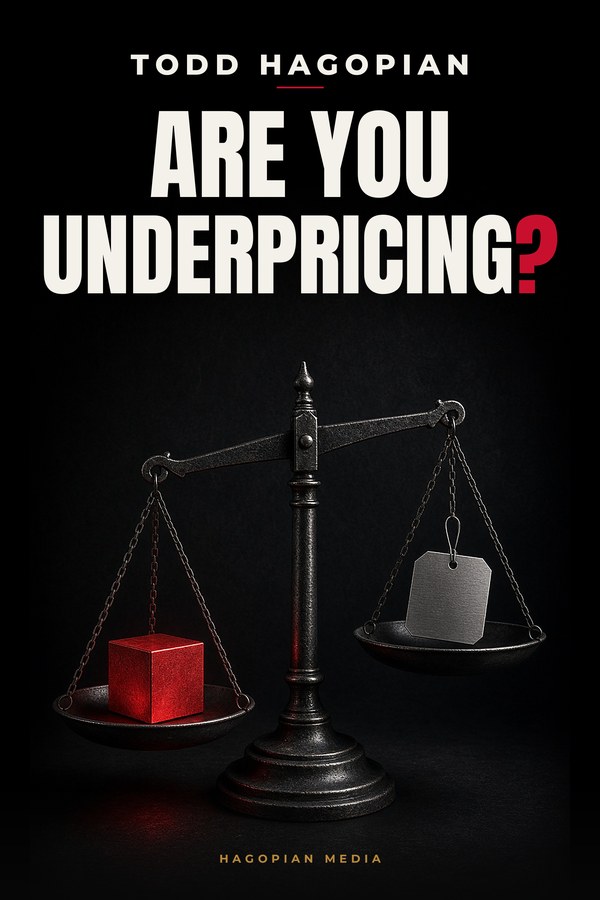
Free minibook · PDF, 27 pages
Find Where Your Pricing Leaves Profit Behind, and Test a Fix Before You Roll It Out
Price too high and you hear about it by lunch. Price too low and you hear nothing. This free minibook shows you how to find where your pricing leaves profit behind, prove it with a controlled test before you touch a list price, and build a price structure that keeps the leak from coming back.
Get Are You Underpricing? free
By Todd Hagopian, who has led business transformations at Berkshire Hathaway, Illinois Tool Works and Whirlpool.
Enter your email, then confirm it. The confirmation email has your PDF link.
Who it's for
Leaders of business-to-business companies, or their commercial side, where costs have climbed for years, gross margin is flat or sliding and the sales team discounts to close. You need price and discount history by account and product, a current cost build for your main products and authority to change prices on at least part of the business.
Not for you if your prices are set by regulation, tariff or a government contract formula, or you sell mainly to consumers through retail. Deciding which customers or products to drop altogether is a portfolio decision; this book prices the business you choose to keep.
What you'll learn
- The Ceiling Nobody Tested
- Margin Math Before Price Moves
- Where Underpricing Hides
- The Rules Nobody Wrote Down
- Test Before You Roll Out
- Tiers, Then Rollout
Plus a final action plan and a worksheet you can use the same week.
Key takeaways
- Customers pay what you ask, not what they'd accept. If nobody asks for more, the gap stays invisible for years.
- Do the margin math before any price move: markup and margin are different numbers, and a break-even table shows how much volume a price increase can afford to lose.
- Underpricing hides in three clusters: legacy accounts, high-complexity configurations and new commercial situations that were never designed as offers.
- Test before you roll out: a contained test group, a control group and a decision rule signed before the first quote goes out.
- Replace one drifting discount ladder with three to five tiers built on volume, complexity and service intensity.
From the book
Every pricing mistake makes noise in only one direction.
Price too high and you hear about it by lunch. A buyer calls. A rep forwards the email with an urgent flag. Someone in the meeting says, "We'll lose them," and the room goes still.
Price too low and you hear nothing.
Customers don't phone to say you left money on their side of the table. The order ships, the invoice clears, and the margin you never asked for never arrives. Because it never arrived, nobody misses it. It gets no variance line, no review, no meeting.
It teaches companies to fear the wrong error. A lost order earns a post-mortem; a thin one earns a handshake. Raising a price feels like a risk that needs a signature. Holding one feels safe. It isn't. A frozen price is a risk nobody had to sign.
Todd Hagopian, Are You Underpricing?, from the prologue "The Silent Error"
Frequently asked questions
If customers would pay more, wouldn't they already be paying it?
No. Customers pay what you ask, not what they'd accept. If nobody asks for more, the gap stays invisible for years. Underpricing is charging less than the value you deliver and the cost you carry would justify, on business where customers would keep buying at a higher price.
Where does underpricing usually hide?
In three clusters: legacy accounts priced years ago to win the business and moved only with token increases since; high-complexity configurations that demand extra engineering, setup or support but carry only a small premium; and new commercial situations, such as a use, bundle or customer type that grew up informally and was never designed as an offer.
How do we find out if customers will pay more without risking the business?
Run a controlled test on a contained slice of the business, with the decision rule signed before the first quote goes out. You don't need an economist. You need a test group, a control group and the discipline not to peek.
Related free minibooks

Plug the Profit Leaks
Find the customers and products quietly draining your margin, then fix, reprice or exit.
Read more
ATM or Money Pit?
Is your growth making money, or eating it? A ten-minute income-statement test.
Read moreRelated reading on the blog
- How Do You Raise Prices After 10 Years?
- Price Elasticity: Test It, Don't Ask Sales
- The Field Guide to a Price Increase
Go further
This minibook is one piece. 10-Minute Transformation: Diagnose and Destroy Your Profit Killers (Koehler Books, out February 23, 2027) carries the full ten-minute diagnostic, the twelve business types, the five structural upgrades and a complete 90-day playbook.
The full library
Two ways to get it. Preorder now and it ships on release. Or buy on launch day, February 23, 2027, and get three free audiobooks (10-Minute Transformation, Stagnation Assassin and The Unfair Advantage) plus the full minibook library, on the honor system. Preorders don't include the launch-day bonuses.
About the author
Todd Hagopian, The Stagnation Assassin, is VP of Product Strategy and Marketing. He has led business transformations at Berkshire Hathaway, Illinois Tool Works, and Whirlpool Corporation, with $3B+ shareholder value across five turnarounds. He speaks to leadership teams on business transformation, turnarounds, and breaking stagnation.